Thousands of prehistoric stone axeheads have been found across Britain and Ireland. They are often beautiful objects but also hold clues to life in the past.
Since 1936 archaeologists in the SWIPG have analysed stone axeheads to pinpoint the type of rock used and exactly where it came from. This is the longest running archaeological experiment and has produced two remarkable conclusions. Firstly, only a few sources of stone were selected by the prehistoric axe makers. Secondly, the axes made from those rocks were transported, sometimes great distances, by complex exchange networks.
This website, funded by Historic England, brings together this archaeological research with a catalogue of axes.
What is a stone axe?
Stone axeheads are found across Britain and were a vital part of prehistoric life. They were used as tools but seem to have had importance and value beyond that.
When were stone axes made?
Stone axes were made between 6,000 and 4,000 years ago. The earliest stone axes were made by the first farming communities. These communities, and the axes they made, would have changed over this long time period.
The timeline below charts the progression through this 2,000 year period.

Timeline
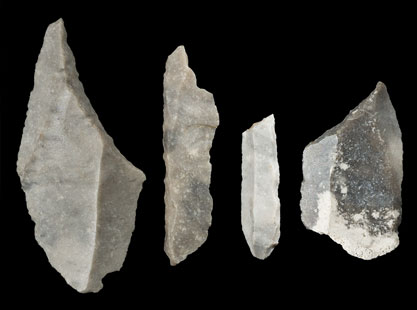
11000 years ago
End of last Ice Age. Groups of hunter-gatherers start to occupy Britain.
Image shows microliths from Links House, Stronsay, Orkney.
© Hugo Anderson-Whymark
6000 years ago
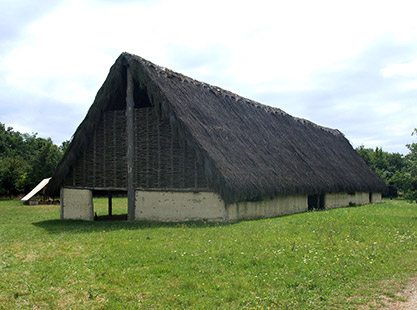
Farming in Britain. This is the start of the gradual transition from hunter-gatherer communities to ones using farming. The first polished stone axeheads in Britain - some of jadeite from the Alps - came with people moving from France.
Image shows a reconstruction (in France) of an Early Neolithic long house dating to around 4000 cal BC. The first people who used stone axes lived in houses like this.
Photograph by Andy M Jones
5800 years ago
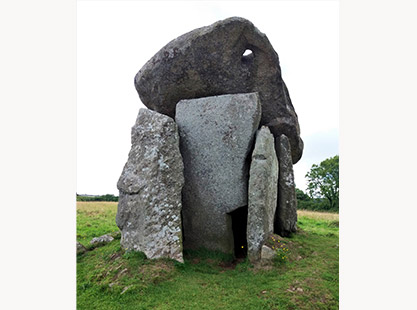
Causewayed and tor enclosures built. Sites with large earthworks are built in places like Hembury near Honiton, Devon and Carn Brea in Cornwall.
Image shows Trethevy Quoit an Early Neolithic portal dolmen / chambered tomb dating to around 3800-3600 cal BC built by communities who would have been obtaining axehead stone in Cornwall.
Photograph by Andy M Jones
5600 years ago
Polished stone axehead production increases.
Image shows a highly polished greenstone axehead from Cornwall. This would have been a highly prized object.
Photograph by Anna Tyacke

5000 years ago
Stonehenge started.
The earliest visible earthworks at Stonehenge date from this point.
Photograph by Andy M Jones

4500 years ago
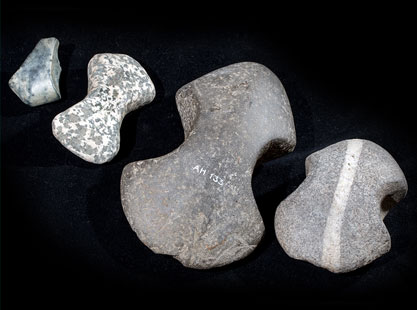
Battle axes in use. These are finely shaped and polished stone tools. Axe hammers in use. These tend to be larger, heavy-duty stone tools.
Image shows battle axeheads from Orkney.
© Hugo Anderson-Whymark, courtesy of National Museums Scotland
4000 years ago
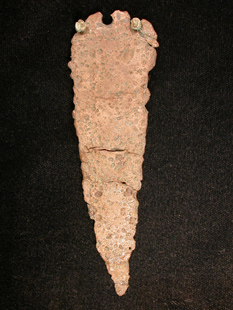
First daggers of bronze made.
Image shows bronze dagger from Fore Down, Cornwall dating to between 1900-1800 cal BC.
Photograph by Anna Tyacke
3500 years ago
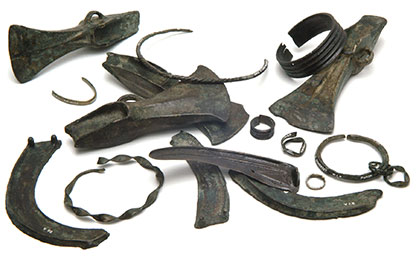
Metal tools and weapons of bronze start to be used.
Image shows a Bronze Age hoard comprising sickles, palstaves, bracelets and rings found in peat near Edington Burtle, Somerset.
Somerset Archaeological and Natural History Society and South West Heritage Trust
2800 years ago
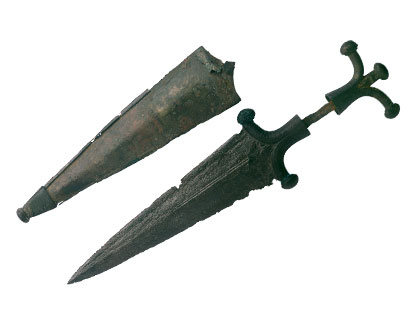
First tools and weapons of iron.
Image shows a dagger and sheath discovered with an Iron Age cremation burial on Ham Hill, Somerset.
Somerset Archaeological and Natural History Society and South West Heritage Trust
2000 years ago
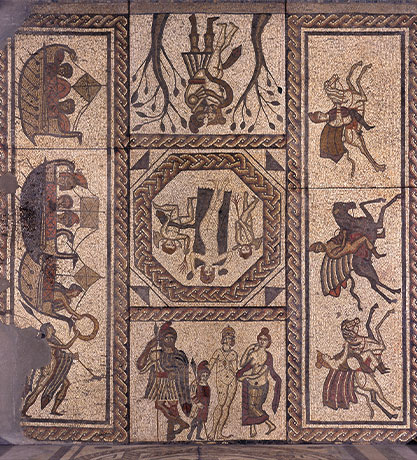
Roman invasion of Britain.
Image shows a mosaic from Low Ham in Somerset.
Somerset Archaeological and Natural History Society and South West Heritage Trust
What are stone axes made of?
The prehistoric axe-makers chose particular types of stone for their axes, often from coastal or mountainous areas. Archaeologists have identified over 30 of these sources and term them petrological Groups I to XXXIV.
Flint was also commonly used to make axes, but this is not the focus of this website.
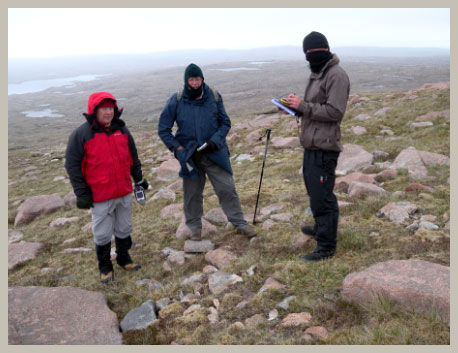
UK Sites

West Penwith, Cornwall
A surprising number of these axes are found in south-east England. They might have got there through coastal or hand to hand exchange networks.
view on map
Great Langdale, Cumbria
These axes are found across Britain. However, the highest concentration of finds is not around the source but across the country in Yorkshire and Lincolnshire.
view on map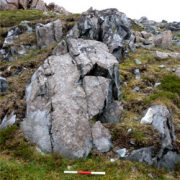
Tievebulliagh Mountain and Rathlin Island, North East Ireland
These axes are commonly found in Ireland. But they have also been found in Scotland and as far south as Kent.
view on mapHow were stone axes made?
Making stone axeheads was a skilled process. It also took a lot of time. Here’s a step-by-step guide.
Step one
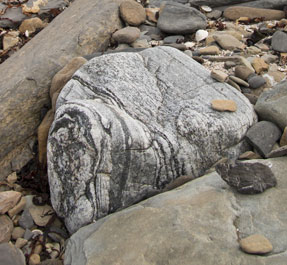
Quarry stone from a rock outcrop or find a beach pebble.
Image shows beach deposits on Stronsay, Orkney.
© Hugo Anderson-Whymark
Step two
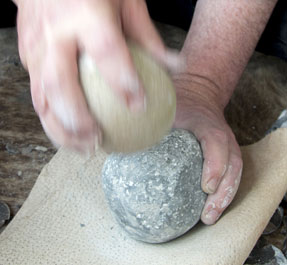
Use a stone hammer to roughly shape your piece of stone. Then using a smaller stone hammer finely ‘peck’ your axehead into shape.
© Hugo Anderson-Whymark
Step three
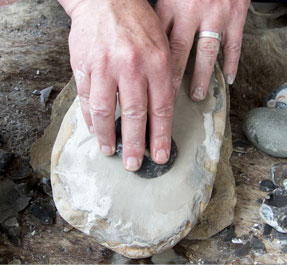
Grind and polish the blade using wet sand on an abrasive stone. (If you want a really fancy axehead, then polish it all over. This will take a very long time.)
© Hugo Anderson-Whymark
What were stone axes used for?
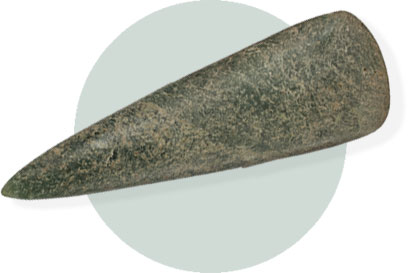
Some axes were everyday tools while others were highly valued as badges of status or for trade and exchange.
Clearing land
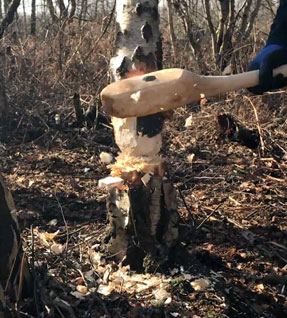
Britain’s first farmers needed to cut down forests to make fields to grow crops and graze their animals. A stone axe was a strong, sharp tool for this job.
Image: AncientCraft – James Dilley www.ancientcraft.co.uk
Construction
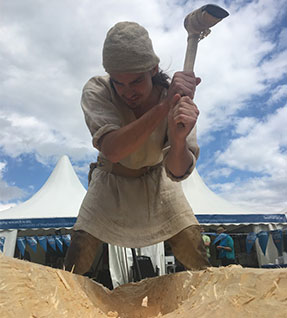
Stone axes were used to shape timber. Their blades were shaped so that they could chip off slivers of wood.
Image: AncientCraft – James Dilley www.ancientcraft.co.uk
Showing off
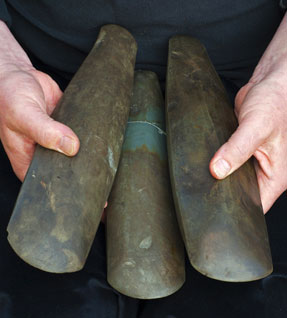
Finely-made axes that came from an exotic, ‘magical’ source were highly valued. These axeheads do not show signs of being heavily used and may have been prized exchange commodities. Having a special axe showed how important you were in a community.
Image: The Belmont Hoard of axes of Langdale Tuff. © Antonia Thomas
What is implement petrology?
Stone axes are one of the few pieces of evidence that survive from life around 6,000 years ago. By identifying the sources of stone used for these axes archaeologists have discovered that these implements were part of complex patterns of trade and exchange.
The South West Implement Petrology Group (SWIPG) originated in the 1920s and 1930s. The Group wanted to understand prehistoric societies through the identification of the geological and geographical origin of stone tools from excavations and museum collections.
Film by Richard Tomlinson
The South West Implement Petrology Group (SWIPG) originated in the 1920s and 1930s. The Group wanted to understand prehistoric societies through the identification of the geological and geographical origin of stone tools from excavations and museum collections.
Film by Richard Tomlinson
The South West Implement Petrology Group (SWIPG) originated in the 1920s and 1930s. The Group wanted to understand prehistoric societies through the identification of the geological and geographical origin of stone tools from excavations and museum collections.
Film by Richard Tomlinson
What next?
The following resources will help you to discover more about stone axes.
Stone axes online

Browse the South West Implement Petrology Group’s full catalogue stone axes.
View catalogue
Learn about long-lost crafts from the prehistoric ages.
Website
A resource devoted to the prehistoric stone tools of Orkney.
WebsiteStone axes on display

Visit the Royal Cornwall Museum, Truro. See the website for opening times and details.
Website
Visit the Royal Albert Memorial Museum, Exeter. See the website for opening times and details.
Website
Visit the The Box, Plymouth. See the website for opening times and details.
Website
Visit The Museum of Somerset, Taunton. See the website for opening times and details.
Website